The fashionable answer to abundance in AI is taste.
When anyone can generate an interface, write a campaign, design a product or produce a strategy, the argument goes, the advantage will belong to those who can distinguish the excellent from the merely competent. Execution becomes cheap; taste becomes the moat.
There is something true here, but the word is too thin. Taste makes organizational advantage sound aesthetic and individual: a gifted founder surveying a hundred possibilities and recognizing the right one. Companies are not built from a succession of inspired selections. They are built from thousands of peculiar decisions that eventually cease to look like decisions at all.
A meeting must never exceed thirty minutes. A machinist can stop the entire production line after noticing an abnormality. A product team must write the press release before writing the code. An engineer applies an apparently unnecessary coating to a barbecue stand because an earlier generation learnt what happens after ten winters without it.
Seen from outside, these are idiosyncrasies. Inside, they become lore, rituals and tricks of the trade. Taken together, they form craft.
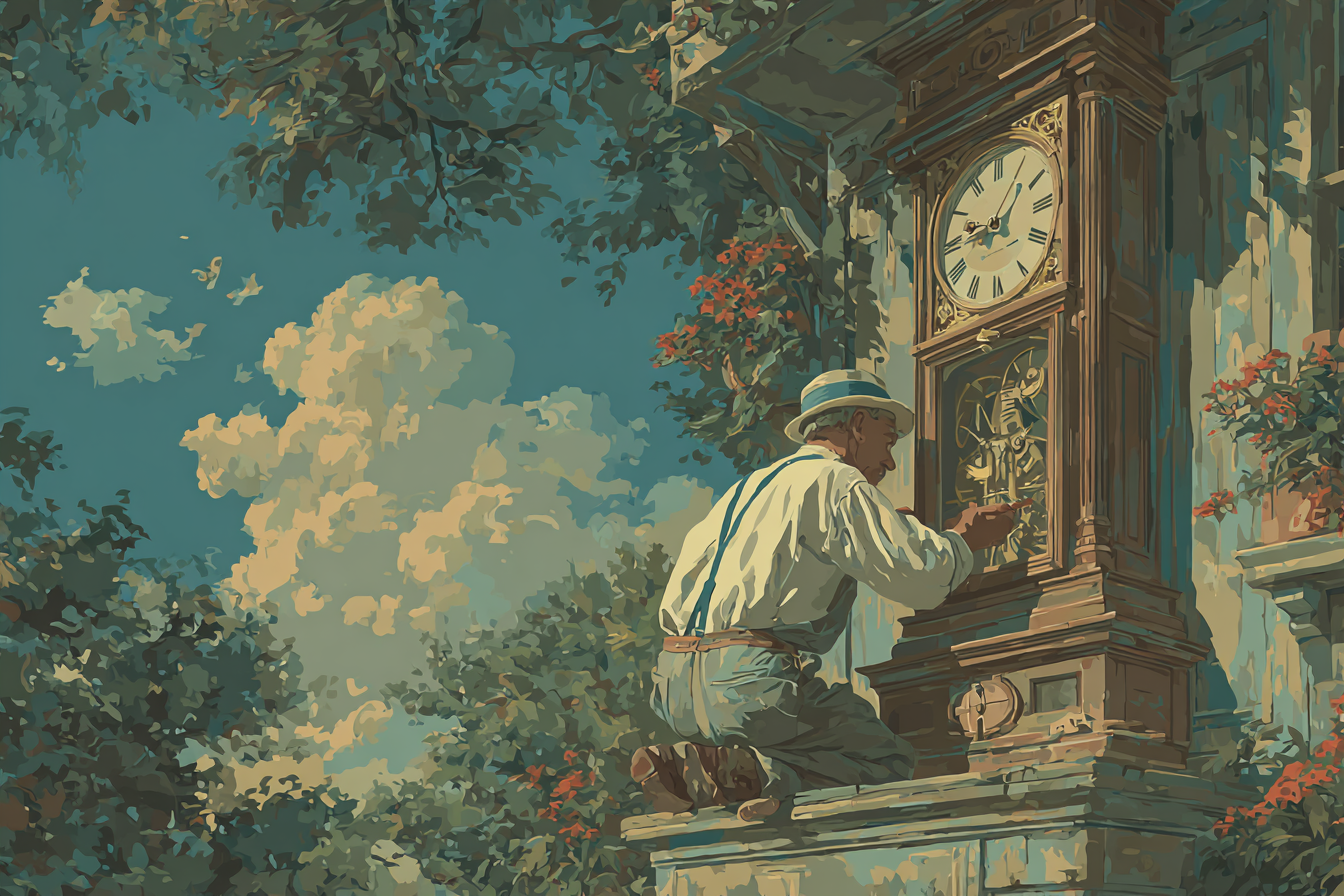
AI will not make craft less important. It will reveal that craft was the real advantage all along.
The destination is not in the data
Organizations are adopting AI unevenly. Some of this is ordinary diffusion: unfamiliar technologies take time to acquire budgets, champions, infrastructure and legitimacy. But AI is not simply another category of enterprise software waiting to be installed.
If intelligence becomes abundant, the central implementation problem will be harness-and-loop engineering. A model must be given access to the right context, permitted to take certain actions, prevented from taking others and supplied with feedback from the consequences. Once these loops are established, every sufficiently deterministic process should improve. Reconciliations will become faster. Inventory will become leaner. Machines will spend less time idle. Sales teams will follow up more consistently.
The metrics will trend towards positive territory.
But a metric contains a hidden decision about what the organization considers good. AI can reduce call-handling time. It cannot determine whether the company should want shorter calls or customers who feel that someone finally owns their problem. It can optimize a supply chain for efficiency. It cannot decide how much redundancy the company is willing to sacrifice before efficiency becomes fragility.
Superintelligence does not solve this problem. It can be superhuman at finding routes without knowing where the company ought to go.
Every optimization requires an objective, a set of constraints and a definition of failure. In consequential organizations, these are incomplete, contested and frequently contradictory. Quality competes with speed. Consistency competes with judgment. Customer accommodation competes with operational sanity. What looks like an optimization problem from a distance becomes a choice of values when observed closely.
The destination is not waiting inside the data.
Craft surrounds optimization
It is tempting to imagine craft as the residue left after machines have automated everything legible. That understates it. Craft does not sit at the end of optimization. It surrounds it.
Craft determines what should be optimized. It recognizes abnormalities while the system is running. It judges whether the technically successful result is actually good.
Toyota’s production system is a useful example precisely because it is one of history’s great optimization systems. Its principle of jidoka allows a machine—or a worker pulling a cord—to stop production when an abnormality appears. The immediate result is inefficiency: the line stops. But Toyota treats that local interruption as the means by which quality is built into the process.
More revealingly, Toyota says work should first be performed and improved by hand. Only after workers understand the task, remove inconsistencies and learn to identify abnormalities should those insights be built into the machine. Automation is not the origin of the knowledge. It is the final expression of knowledge acquired through practice. Toyota calls this combination “automation with a human touch.”
This is craft becoming infrastructure.
The same pattern appears in less mechanical settings. Amazon famously replaced presentation decks with narratively structured six-page memos that participants read silently at the beginning of a meeting. The ritual is superficially inefficient. Why make highly paid executives sit together and read something they could have skimmed earlier?
Because the practice encodes several beliefs: that prose exposes gaps hidden by bullet points; that the audience should encounter the complete argument rather than the presenter’s performance; and that shared reading creates a common evidentiary base before debate begins. Jeff Bezos noted that a strong memo might require a week or more to produce. The point was not the six pages. It was the standard of thought the constraint forced into existence. The memo was a writing format turned into an operating mechanism.
AI can draft the memo. It cannot, merely by drafting it, create the culture that refuses to accept muddy thinking.
The company is its consequential peculiarities
Not every organizational quirk deserves to be elevated into craft. Some are obsolete workarounds. Some are bureaucracy fossilized into tradition. Others are simply the founder’s anxieties distributed across the company.
A thirty-minute meeting rule may create decisiveness. It may also create shallow decisions followed by clandestine follow-up meetings. An engineer’s obsession with a hinge may produce a product that feels indestructible. It may equally be technical vanity lavished on something the customer never notices.
Idiosyncrasy becomes craft only when it repeatedly protects something the organization has chosen to care about.
Pixar’s Braintrust illustrates this distinction. Experienced storytellers candidly criticize a film in development, but the group has no authority to prescribe changes. The director remains responsible for the solution. Ed Catmull wrote that this absence of authority was crucial: it freed the group to be unvarnished and the director to listen without surrendering ownership. When Pixar tried to transfer the practice elsewhere while giving the review group authority, the dynamic broke. The ritual worked because of its precise social architecture, not because “feedback is good.”
An AI could summarize the discussion, compare the film with thousands of successful stories and predict where audiences might lose interest. But the Braintrust’s value lies partly in a more delicate achievement: separating criticism from command while preserving candour. That is organizational knowledge embedded in a ritual.
Copy the meeting and you may not copy the craft.
What happens when intelligence becomes cheap
As AI spreads, companies will converge first where the objective is clearest. They will price more accurately, schedule more efficiently, detect more defects and generate more competent work. Once one company discovers a measurable optimization, vendors will package it and competitors will acquire it.
The advantage will move elsewhere.
It will move towards the organization’s consequential peculiarities: the standard nobody can fully justify but everyone has learnt to recognize; the exception an experienced operator refuses to automate; the ritual that preserves candour; the unnecessary coat of paint that turns out, seven years later, to have been necessary.
Perhaps AI will eventually learn these too. Once a piece of craft becomes observable, explainable and repeatable, it can be encoded into the loop. But that does not eliminate craft. It moves its frontier. The organization must still confront new situations in which evidence is incomplete, feedback is delayed and the definition of good remains unsettled.
This is why taste is not quite the moat. Taste is only the ability to recognize a difference before the difference can be fully measured.
Ingenuity discovers the difference. Taste discriminates between possibilities. Craft embodies the choice in practice. Lore remembers why it matters. Ritual transmits it after the people who discovered it are gone.
AI will optimize within the world an organization gives it. Craft decides which world that organization inhabits.