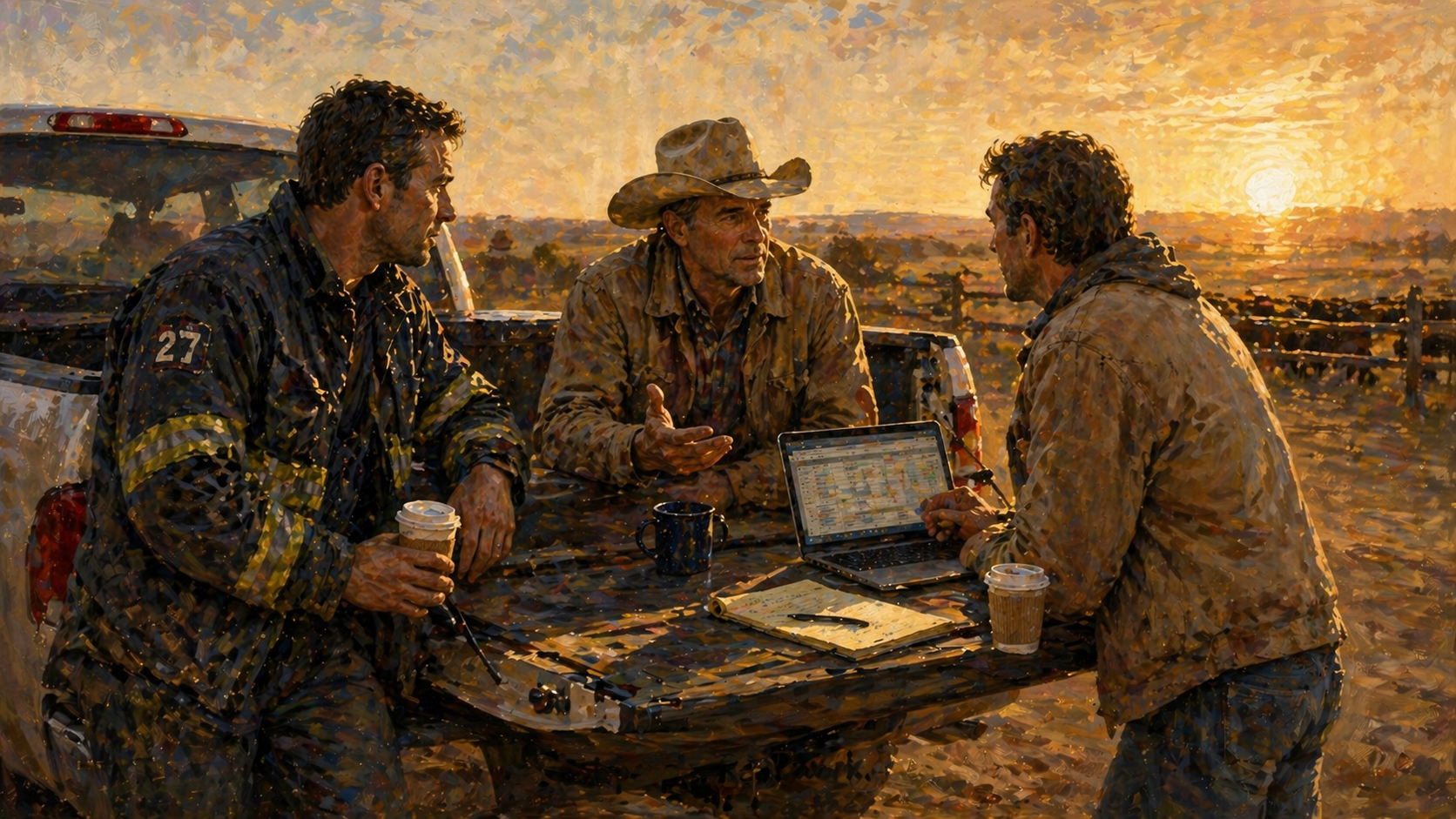
Tom is a firefighter.
Years ago, we built him what was basically an Excel-spreadsheet version of AI. No agents. No copilots. No white paper about the future of work. Just a thing that helped him make better decisions under pressure.
Every three months, Tom still pings us with a question. We spend a couple of hours with him. He gets what he needs. Then he disappears back into the field.
That is how AI will reach most of small-business America. Not as transformation. As a recurring favor that slowly becomes infrastructure.
Then we met Earl.
Earl owns cows. Earl bids loudly at auctions. Earl has the kind of market intelligence no dashboard has ever captured: who is desperate, who is bluffing, who overpays when his brother-in-law is watching, and who says “final bid” three times before actually stopping.
When we suggested AI could help him decide what to bid, Earl looked at us like we had brought a violin to a gunfight.
“I don’t care how fancy your AI is,” he said, “because no one else is using the fancy AI. Morons will bid as they bid.”
That sentence is a better theory of AI diffusion than most consulting reports.
Because Earl was not rejecting AI. He was rejecting the fantasy that intelligence alone changes a market. In his world, price is not discovered by a model. It is discovered by ego, weather, habit, rumor, credit, testosterone, and two men pretending they are done bidding.
Small-business America is full of Earls and Toms.
Pet food safety inspectors. Environmental auditors. Fire commanders. Cow auctioneers. Regional insurance adjusters. Septic tank operators. Used machinery brokers. Port clerks. The people who run the country while LinkedIn debates whether AI will replace product managers.
They do not call it ChatGPT. They call it “Chat.”
Their sons are in BCG, product management, or private equity. Occasionally the sons join the calls. They are articulate, polished, allergic to mess, and armed with frameworks. The fathers are less articulate, less polished, and somehow know the exact buyer in Oklahoma who will pay 12% above market if the lot closes before lunch.
The sons understand AI. The fathers understand the business. Neither can quite explain the other.
James is like Earl and Tom, except James is a teacher. He sat us down and explained what would work and what would not.
James does not need “better workflows.” He does not know what that means. He does not care about hallucination rates, because the damned thing had better be right. What do you mean it will be wrong occasionally?
James has a simpler question.
Does he ask Sarah not to retire, or does he use AI so Sarah can finally go part time?
That is the real adoption curve.
America has thousands of successful small businesses that are good but will not grow, because greatness does not scale. Their edge lives in people. In Sarah. In the person who knows which buyer is trouble, which inspection note matters, which customer always complains, which form gets missed, which vendor needs a phone call instead of an email, and which “urgent” issue can safely wait until Tuesday.
Every one of these businesses has a Sarah.
And every one of them knows Sarah will retire.
So how do you sell AI to James?
I don’t know if you sell it the way software is usually sold. James, Earl, and Tom go duck hunting together. They are happy making an extra buck if AI can help. They are not shy about telling their buddies about the guy who does this AI thing for them.
That is how diffusion works here.
Not through analyst reports. Not through transformation decks. Not through a webinar called “Unlocking AI for the Future of Work.”
Earl gets Sarah-but-faster. Earl tells his friends. His friends bring their own weird businesses, grudges, spreadsheets, rules of thumb, and retiring Sarahs. We build software for an industry no one cares about. But we do not build it from the outside. We build it with Earl.
That is why we built The Guild.
AI diffusion in enterprises is about reliability. In mid-markets, it is about where to begin and whom to trust. In small-business America, it is about solving the Sarah retiring problem.