
TL;DR
- Three complaints about AI implementation are all true at once: the tooling is unstable, the output is hard to trust where trust is the job, and the economics of frontier and open models both have problems. AI is delivering anyway.
- The small operator's advantage is that she knows which rocks to turn over. No vendor does. One cash leak at a time beats a transformation program.
- At the other end of the size range, speed comes from a board member being on the call, not from a better evaluation of the tool stack. Committees kill pilots by doing their jobs properly.
- The unit of progress is a two-week milestone. Fail and recover inside a fortnight rather than closing the door on experiments.
Depending on whom you talk to you get one of the three immutable truths about AI implementations:
- The tooling is unstable, observability is difficult, and security is a nightmare
- Whatever works is magical, but when the job depends on not trusting it, it's hard to implement
- Frontier models are great but their economics are bad. Open models are decent but their attention is as wayward as a toddler's.
The beauty of the current wave of AI at work is that all of these are true and AI is already delivering—warts and all. That 'emdash' is mine and you can judge me. So what is the mindset of someone who is implementing and if you are in the 'waiting' camp, what should you know about the 'doing' camp?
The attorney and the tower
Anecdote 1:
I spoke to an attorney who is now a telecom tower leasing expert. I meet these interesting people because I pound the pavement in Middle America. How else can you know that power transmission companies have no idea what to charge carriers for tower access? Do you even know that telcos place their equipment on transmission towers?
This expert and I are now developing an AI-based system for utility lease pricing and provisioning because this area falls into a no-man's land. Even vertical software companies don't care to know that such crabs exist under such rocks.
Why am I saying this?
You know which rocks to turn over. Not the vendors. And you know that anything that comes up is a bonus. No job loss. No multi-quarter plans. Just take the plunge and solve one cash leak.
Lesson? Doers just do. One cash leak or one sentiment analysis at a time. Transformation is for big enterprises. For you, its just turning a rock. Why this kind of work never made it into software in the first place is the argument in The Mess Just Got Cheap.
The public company that moves anyway
Anecdote 2:
Public company. Polar opposite. Regulated operations. They move fast too. How? The board member is on the call. The prize is so large that even a half-working AI is worth the price. Those who execute at scale don't evaluate the technology. They evaluate the outcome assuming two more iterations, twice the cost, and double the engineering effort compared to our initial estimate for the agent. Spending $250K to improve the collection efficiency of a $500M business is a no-brainer.
Yet, committees engulf and kill pilots. Why? It's their job to do the right thing: Evaluate the tool stack, fret about scalability, debate build vs. buy, and so on. The will to do something often resides with a different person, and they don't work in the rooms where pilots are designed.
I recall Jeff Bezos' ultimatum to Amazonians: Become API-first, or leave.
Yes, we are discussing change management but executives phrase it as something for the hoi polloi. It's the problem of the others. But right at the top, many organizations consistently miss that momentum begets progress and progress begets value. The full version of this argument is in The Two Million Dollar Shrug.
Lesson? Your first AI rollout is an experiment, but one where failure should not be a track-ending milestone. Define bets tied to short milestones. A milestone every two weeks. Fail and recover within a fortnight instead of shutting the doors on experiments. Pick easy wins first. Hard ones get you the grand prize but win battles first.
Clarity is faster than you think
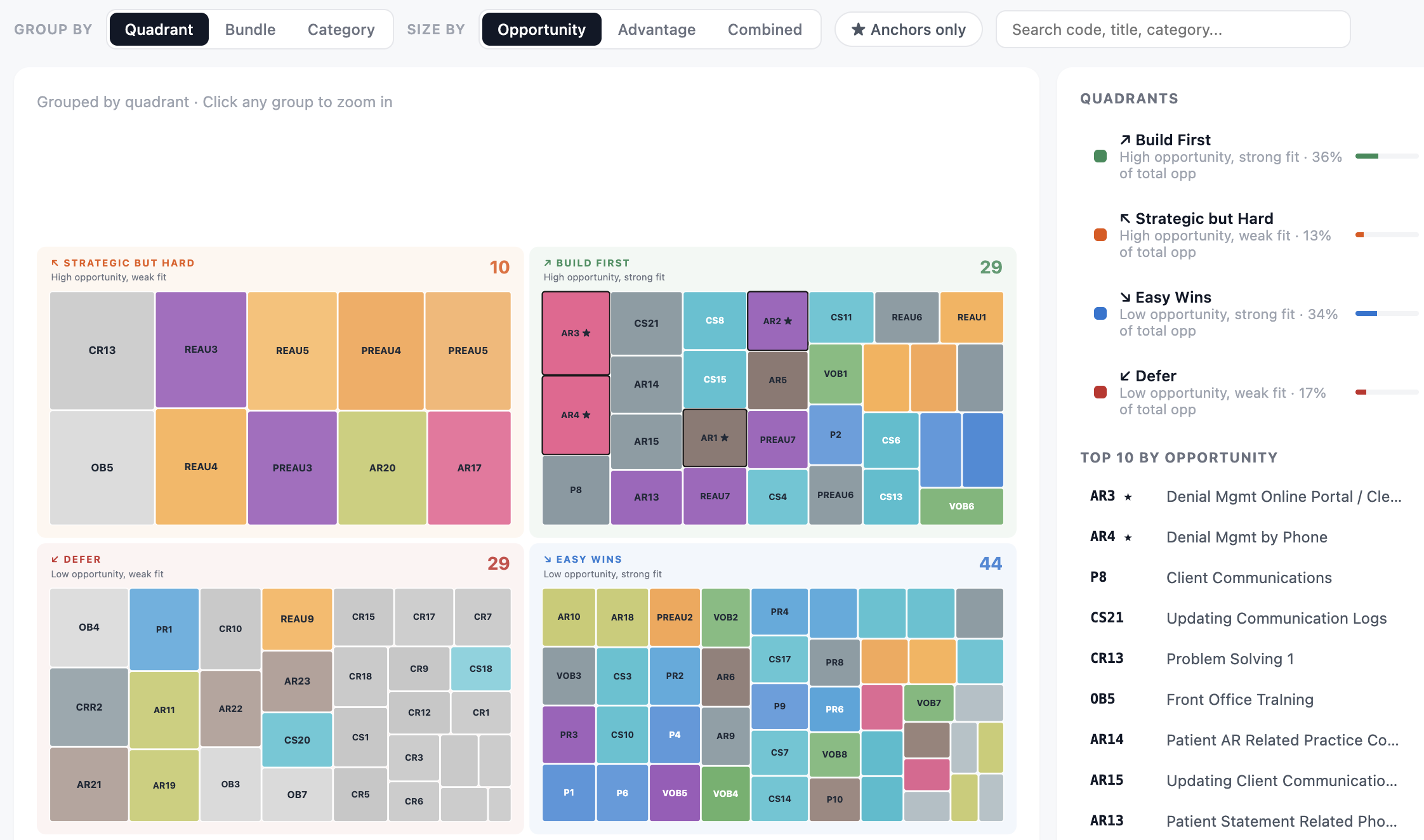
I want to leave you with one image.
You can now get from a vague notion of "we want to do AI but don't know where to begin" to a "McKinsey level clarity and conviction" within a week. We did this several times over, mapping workflows, what value AI unlocks for each workflow, and what it takes to roll out those AI systems – making it a beautiful set of stack ranks and score cards.
If you are an executive who also executes, remember this:
- Just pick one thing and do it
- Make the cost of experimentation low enough that it does not matter. Two-week cycles of wild goose chases over 3 months takes you farther than getting a consulting firm to squat in your office for a quarter
- You can go from "I don't know where to begin" to "definitive answers" in days. Anyone that says otherwise lacks resourcefulness
Now that you are here, read what we have at https://moative.com/foundry.
We have 35000 readers.
Roughly 10 of them will act after reading it.
Those are the doers' doers.
Where Moative fits
Moative is built around this two-week rhythm rather than around a transformation program. The Foundry exists for the second case in this essay: operators who recognize their own pain as their industry's pain and want to co-own the system that fixes it rather than rent one. In healthcare revenue cycle management the first rock is usually a single cash leak that nobody has measured.
Frequently asked questions
How long should an AI pilot take?
Structure it as a chain of two-week milestones rather than as one long pilot. A fortnight is short enough that a failure is recoverable and long enough to produce something real. Long pilots concentrate all the risk at the end, which is exactly when an organization is least able to absorb bad news.
Why do AI pilots get killed by committees?
Because the committee is doing its job. Evaluating the tool stack, questioning scalability and debating build versus buy are all reasonable. The problem is structural: the person with the will to change something is usually not in the room where the pilot is designed, so caution has a voice and conviction does not.
Where should a mid-market company start with AI?
With one measurable cash leak you already know about. Not a transformation program, not a strategy offsite. The advantage a smaller operator holds over any vendor is knowing which rock is worth turning over, and that advantage is wasted on a broad program.
How much does it cost to get clarity on an AI roadmap?
Far less than it used to, and it takes days rather than quarters. Mapping the workflows, identifying where a model actually changes an outcome, and ranking the options is now a week of work, not a consulting engagement.
Is AI worth it if the technology is still unstable?
Both things are true at once. The tooling is immature, observability is genuinely hard, and trust is the binding constraint wherever the job depends on being right. Work is still being delivered today. The question is not whether the technology is finished but whether a specific leak is worth closing with what exists now.
What makes large regulated companies move quickly on AI?
Sponsorship at the top and a prize large enough that an imperfect system still pays. They evaluate the outcome while assuming the build will take more iterations and more money than estimated, rather than evaluating the technology on its current state.